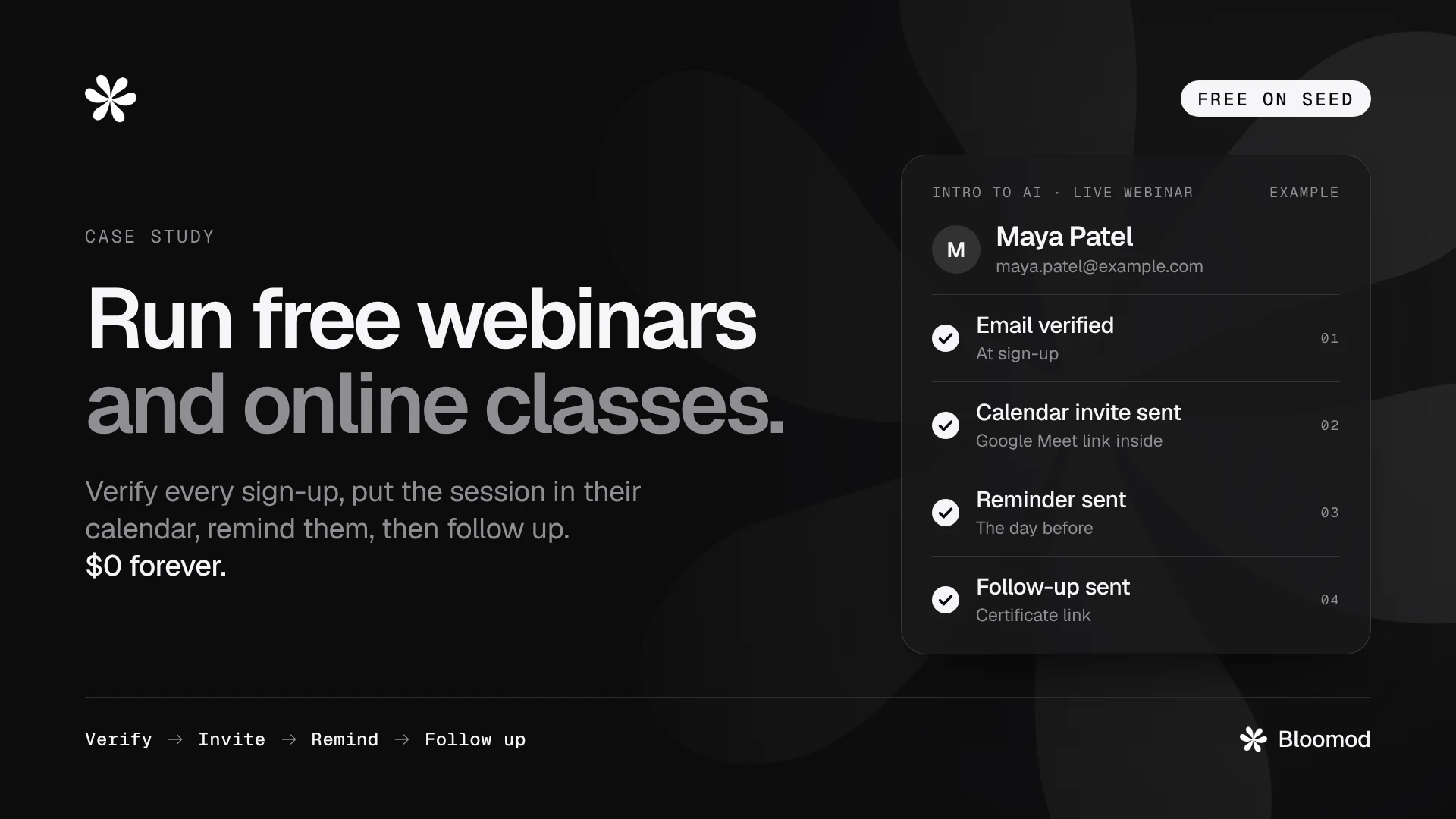
Case study
How colleges and universities get students to show up: calendar invites and reminders
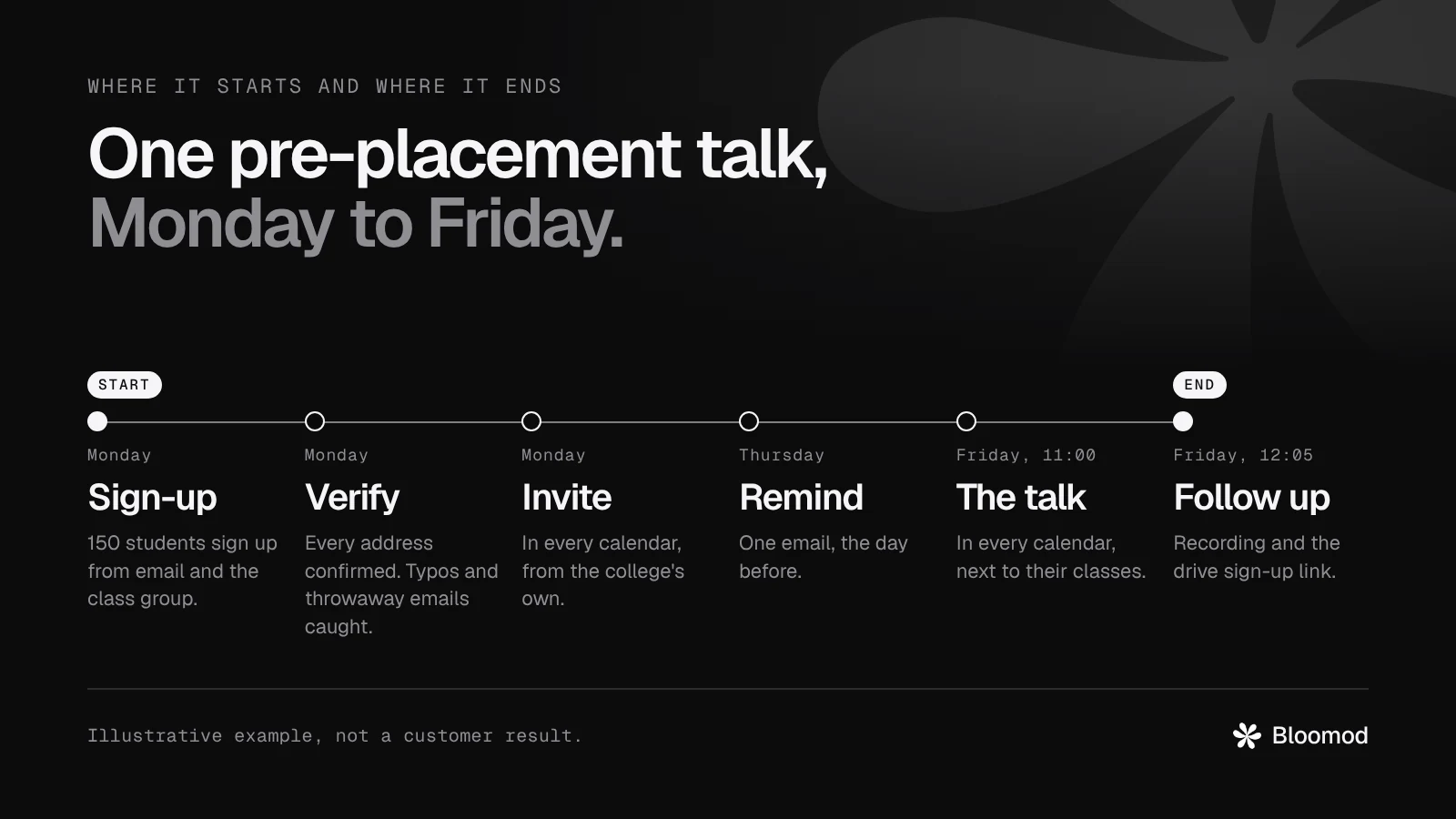
One pre-placement talk, Monday to Friday: how verifying sign-ups, sending calendar invites from the college's own calendar, reminding students the day before and following up gets students from the sign-up form to the seat.
By Bishal
Published Updated 7 min read
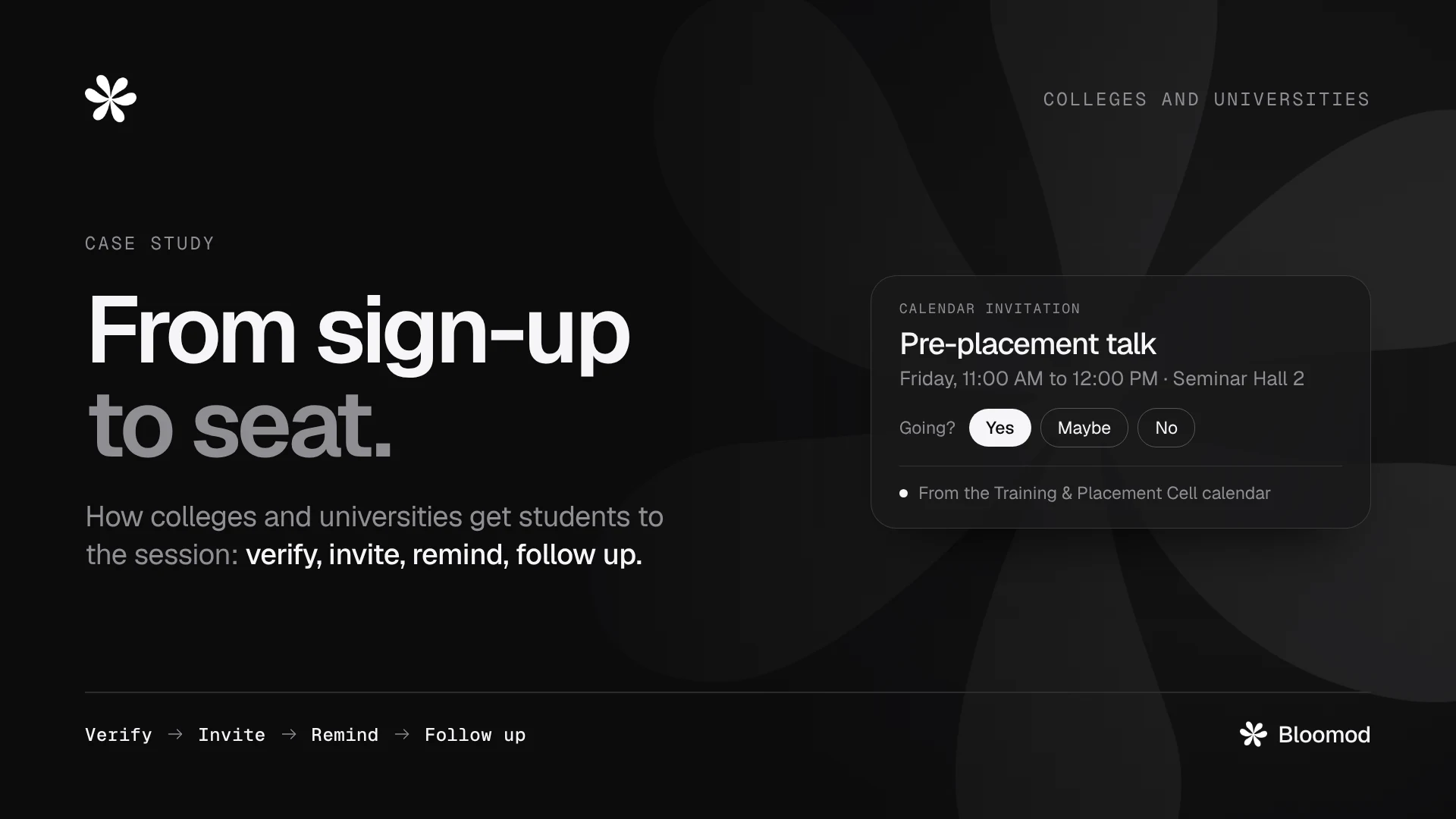
The short answer: colleges and universities get more students to show up when a sign-up becomes a real calendar event. Verify each email address, send the invitation from the institution's own Google or Microsoft calendar, remind students the day before, and follow up after the session.
An illustrative example, built from published research and how Bloomod works today. It is not a customer result. Sources are listed at the end.
Where it starts: 150 sign-ups and no idea who will come
It's Monday. A placement officer announces a pre-placement talk for Friday at 11:00 AM. The notice goes on the college email and in the final-year group. By evening, 150 students have filled in the form.
A few addresses have typos. Two are throwaway emails. By Wednesday, the notice is buried under a hundred newer messages. On Friday, the officer finds out who was serious when the hall fills up, or doesn't.
US universities live the same week with orientation sessions, employer info sessions and office hours.
Why students miss sessions they signed up for
- A sign-up costs nothing. Filling in a form takes seconds, so it carries little commitment. At one US university, career staff reported that half or more of event sign-ups did not attend. At one employer event, 53 signed up and 15 came.
- The notice gets buried. In a 2026 survey of 1,188 students at Georgia Gwinnett College, nearly three-quarters said they get too many messages, and students asked for one central events calendar. A student at Leeds put it simply: "There were so many emails being sent out that I basically just gave up" (Times Higher Education).
- Group chats move fast. In many Indian colleges, the real channel is a class WhatsApp group, where a notice scrolls away within hours. St. Xavier's College, Jaipur now warns students that unofficial groups "often circulate unverified information".
- Staff can't see who is coming. So colleges punish absence after the fact: a ban from the next placement drive, a parent visit to the T&P cell (YCCE), or a $25 no-show fee at some US career centers (NACE).
The fix: four steps, from sign-up to after the session
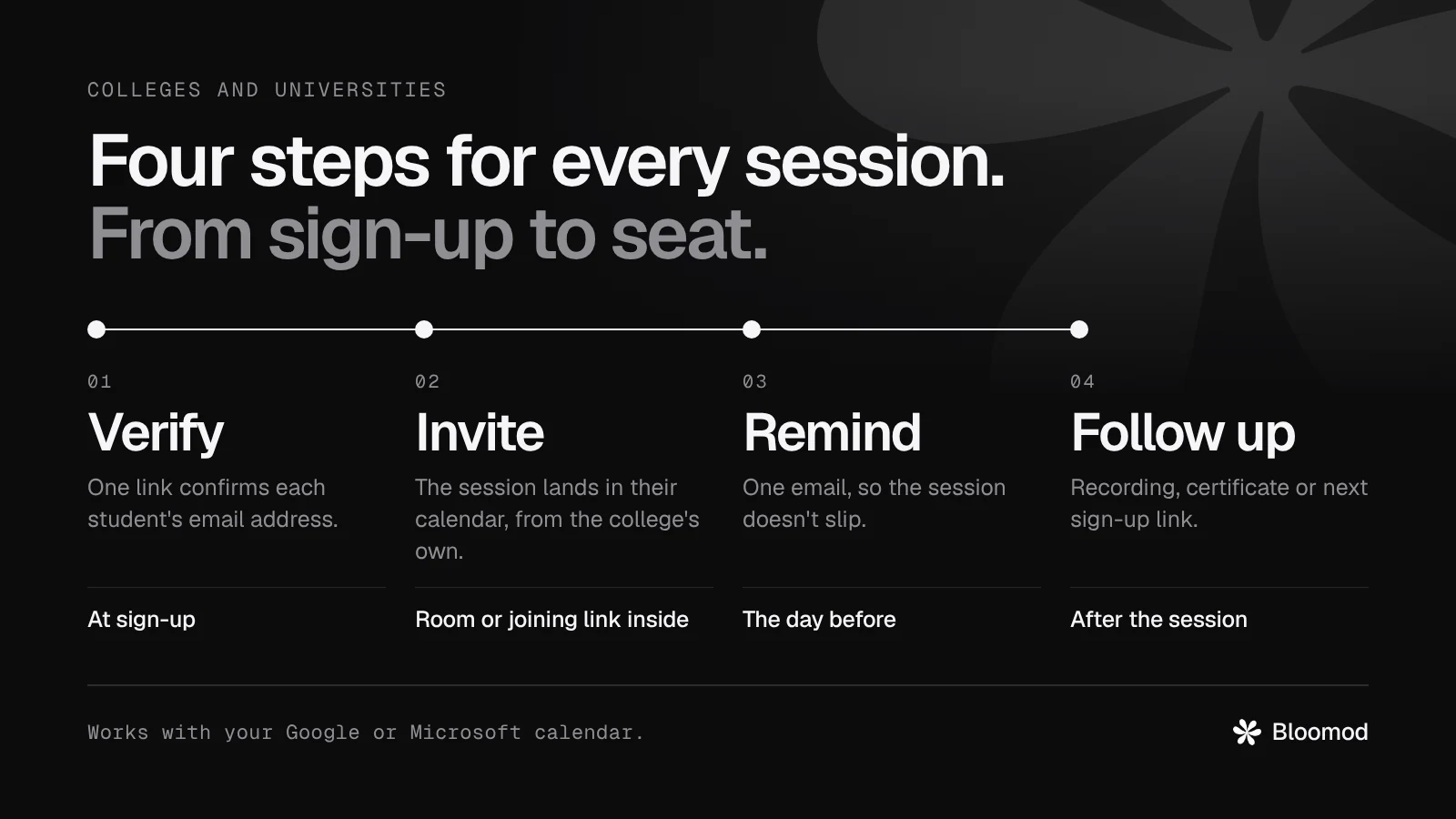
- Verify. Each student confirms their email address with one single-use link. Typos and throwaway addresses are caught at sign-up, not on the day.
- Invite. The session lands in the student's calendar as a real invitation from the college's own Google or Microsoft calendar, with the room or the joining link inside.
- Remind. One reminder email goes out the day before. One, not five.
- Follow up. After the session, students get the recording, a certificate link, or the sign-up link for the next drive or class.
Where it ends: Friday, 11:00 AM
By Thursday, the placement officer can see which email addresses are verified and that every invitation went out. The reminder reaches students that morning, a day ahead.
On Friday, the talk sits in every student's calendar with the room and time, next to their classes. When it ends, every student who was invited gets the recording and the link to sign up for the placement drive.
Nobody can promise a full hall. What changes is that no student misses the talk because a message got lost, and the T&P cell no longer has to guess.
In India: induction, pre-placement talks and placement drives
- Student Induction Programme. UGC's Deeksharambh guidance says induction "shall be mandatory for all the fresh students". Create one event per induction session, so each day of the schedule sits in every new student's calendar.
- Pre-placement talks and placement drives. Swap penalties after the drive for confirmation before it. Send invitations to the official college email ID, which placement policies such as GMRIT's already require students to use.
- Placement training. Where training attendance decides eligibility, remind students the day before each session and send the certificate after the last one.
- Mentoring and doubt-clearing sessions. Small sessions are missed most easily, so a calendar invitation helps most there.
In the US: orientation, career fairs and office hours
- Orientation and Welcome Week. At West Chester University, 14.2% of 2,408 new students had no engagement with virtual orientation in 2020. Put each session in their calendar before the semester starts.
- Career fairs and employer info sessions. Verified sign-ups give employers a real headcount, and the day-before reminder protects the turnout.
- Office hours and advising. In one widely cited survey, two-thirds of students had never been to office hours for their course. A standing calendar invitation makes them hard to forget.
- Admissions information sessions. Follow up with the application link while the session is fresh.
What the research says, and what it doesn't
- Specific, personal reminders work. In a randomized trial with 4,882 students, personal reminders about pre-enrollment tasks raised college enrollment by about 3 percentage points, and by almost 6 for the lowest-income students (trial brief).
- Generic messages at scale don't. Reminder campaigns that reached more than 800,000 US students had no effect. One of the researchers points to senders students didn't know and messages that weren't personal. That's why the invitation should come from the college's own calendar.
- A date and a time help. People follow through more often when a plan has a specific date and time (NBER). In one US government trial, adding a calendar invitation lifted completion by 13.5% in relative terms.
- Not yet tested: a calendar invitation for a student session. No published study has measured it. If your college would like to measure it with us, write to [email protected].
What it costs
- Seed, free: 2,000 calendar invitations and 200 emails a month. With all four steps, that covers about 66 students a month.
- Stem, $29 a month: 4,000 invitations and 3,000 emails, enough for about 1,000 students a month through all four steps. It also sends emails from your college's own domain, and RSVP Reporting shows who accepted.
See pricing for details.
Frequently asked questions
Does it work with our Google Workspace or Microsoft 365 account?
Yes. Connect the college's Google or Microsoft calendar, and every invitation goes out from it. Students receive it in Google Calendar, Outlook or Apple Calendar.
Can one invitation include both the room and an online link?
Each session has either a venue or a joining link. For a hybrid session, add the other one to the description, which goes into the invitation.
Can students get a certificate after a training session or pre-placement talk?
Yes. Add the certificate link as the button in the follow-up email, and every invited student receives it after the session.
Do you send reminders on WhatsApp?
Not today. Reminders go out by email, and the session already sits in the student's calendar, which can alert them too.
How many students can attend one session?
Bloomod sets no limit for an in-person session or your own meeting link. Google Meet sessions are capped at 200 students per event.
Does verification confirm that a student is enrolled?
No. It confirms the student owns the email address and blocks throwaway addresses. To keep a session to your own students, ask them to register with their official college email.
Sources
- GW Hatchet: Career services reprimands students for not showing up to employer events (2017)
- Georgia Gwinnett College: Student survey highlights need for smarter, more targeted communication (2026)
- Times Higher Education: Students feel spammed by university emails
- St. Xavier's College, Jaipur: Notice on unofficial social media groups (2026)
- YCCE Training and Placement Policy 2026
- GMRIT Placement Policy
- NACE: Holding no-show students accountable
- UGC Deeksharambh: Student Induction Programme guide
- West Chester University: New Student Programs annual report 2020–21
- The Teaching Professor: Students don't attend office hours
- Reducing Summer Melt (randomized trial brief)
- Batten School: Nudging at scale, FAFSA completion campaigns
- Behavioral Scientist: Why aren't text message interventions designed to boost college success working at scale?
- NBER: Using implementation intentions prompts to enhance influenza vaccination rates
- US GSA Office of Evaluation Sciences: Calendar invite trial