How RSVP Tracking Raises Show-Up Rates for B2B Events and Webinars
Email opens and clicks don’t tell you who will attend. Explore calendar RSVPs, published research and a transparent 500-registrant planning scenario.
By Bloomod · Last reviewed 18 Nov 2026
Quick answer
Track calendar RSVPs, not email opens, if you want to know who will show up. An email open can be triggered automatically by privacy features, and a click shows curiosity. A "Yes" on a calendar invite is a decision: the event lands on the guest's calendar with a date, time and place. Research on plan-making shows that prompting people to commit to a specific date and time raised follow-through by about 4 percentage points in two large field experiments. Bloomod records Accepted, Tentative, Declined and No reply straight from the calendar invite, for free, so you can brief each group at the right moment.
The challenge: opens and clicks don't predict attendance
Most event teams judge an invitation by its email metrics. The problem is that neither metric measures intent to attend.
- Opens are no longer reliable. Since Apple's Mail Privacy Protection launched in September 2021, Apple Mail can pre-load email content through a proxy. The tracking pixel fires whether or not a person reads the email. Litmus reported that Apple's mail apps accounted for 49.8% of tracked email opens by August 2021. [1]
- Clicks show interest, not a plan. A click means someone looked at your event page. It doesn't say whether they cleared their calendar.
- Registrations aren't attendance. Even for webinars, where joining takes one click, ON24 reports that the average registrant-to-attendee conversion rate was 60% in 2025. [2] This is an aggregate platform benchmark, not a guaranteed live-session attendance rate for an individual event.
The result: organizers send the same reminder to everyone, can't tell committed guests from undecided ones, and find out who's coming only when the event starts.
What the research says
There are no published trials comparing "RSVP tracking" with "open tracking" for events specifically. But two well-studied mechanisms explain why a calendar RSVP is a better signal, and why prompting it can lift attendance.
1. Concrete plans increase follow-through
Psychologists call a specific "when, where and how" plan an implementation intention.
- Meta-analysis: Across 94 independent tests, forming implementation intentions had a medium-to-large positive effect on goal attainment (d = 0.65). [3]
- Flu vaccination field experiment: In a randomized trial with 3,272 employees, a mailer that asked people to write down the date and time they planned to get vaccinated increased vaccination from 33.1% to 37.1%, a 4.0 percentage-point increase (4.2 points after regression adjustment). [4]
- Voter turnout field experiment: In a study of 287,228 voters, a call that helped people form a voting plan raised turnout by 4.1 percentage points among those contacted. Among single-voter households the effect was 9.1 points. A standard encouragement call had no significant effect. [5]
- Why it works: Rogers, Milkman, John and Norton summarize that planning prompts work because "scheduling tasks makes people more likely to carry them out," and because plans help people remember to act at the right moment. They describe a commitment recorded on a calendar as an explicit commitment people are reluctant to break. [6]
A "Yes" on a calendar invite can support that kind of plan. It fixes the date, the time and the place, and it puts them where the guest manages their day.
2. Timely reminders reduce no-shows
- A systematic review and meta-analysis of 26 studies found that people who received digital appointment notifications were 23% more likely to attend (risk ratio 1.23). Attendance was 67% with notifications versus 54% without. [7]
Calendar apps can remind guests before an event starts, and an RSVP gives the organizer a reason to send the right reminder to the right person.
These studies come from vaccination, voting and healthcare appointments, not from B2B events. We use them to explain the mechanism and to size a planning scenario, not as proof of a specific result.
A research-based scenario: 500 registrants
To make the research practical, here is a planning scenario. The baseline and assumed effects use the sources above; projected attendance is calculated from those assumptions. The RSVP split is a planning figure.
| Input | Value | Source |
|---|---|---|
| Registrants for a B2B webinar or seminar | 500 | Planning figure |
| Average registrant-to-attendee rate | 60% | ON24 benchmark, 2025 data [2] |
| Expected attendees at benchmark | 300 | 500 × 60% |
| Expected no-shows at benchmark | 200 | 500 − 300 |
| Effect of a date-and-time plan prompt | about +4 percentage points | Flu (+4.0 pp) and voting (+4.1 pp) field experiments [4][5] |
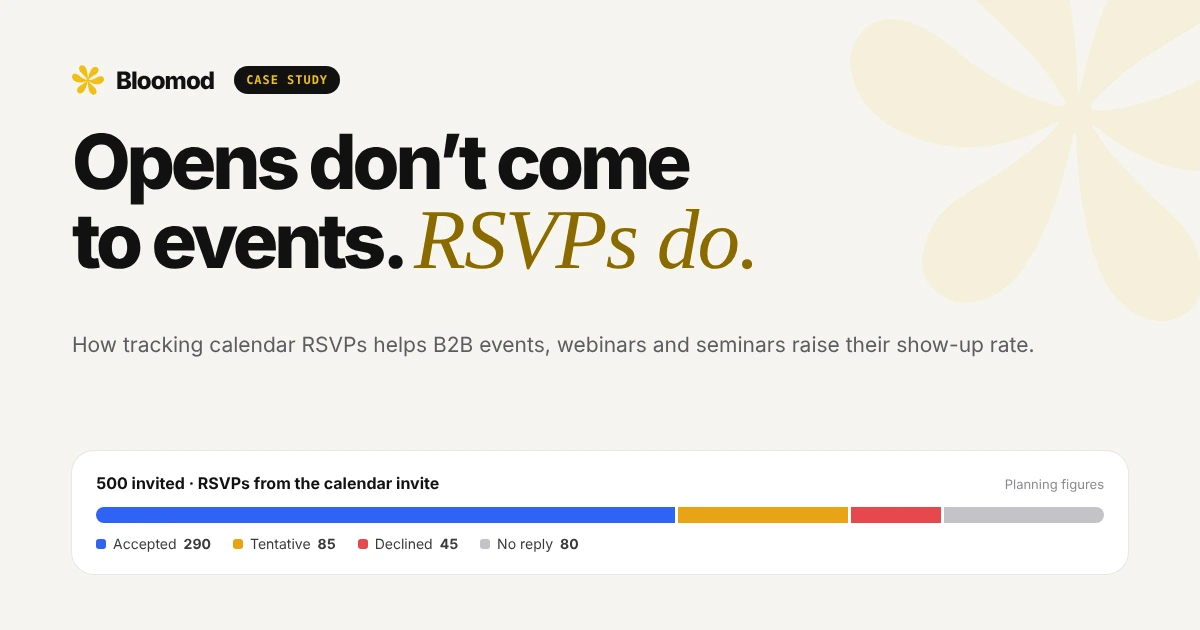
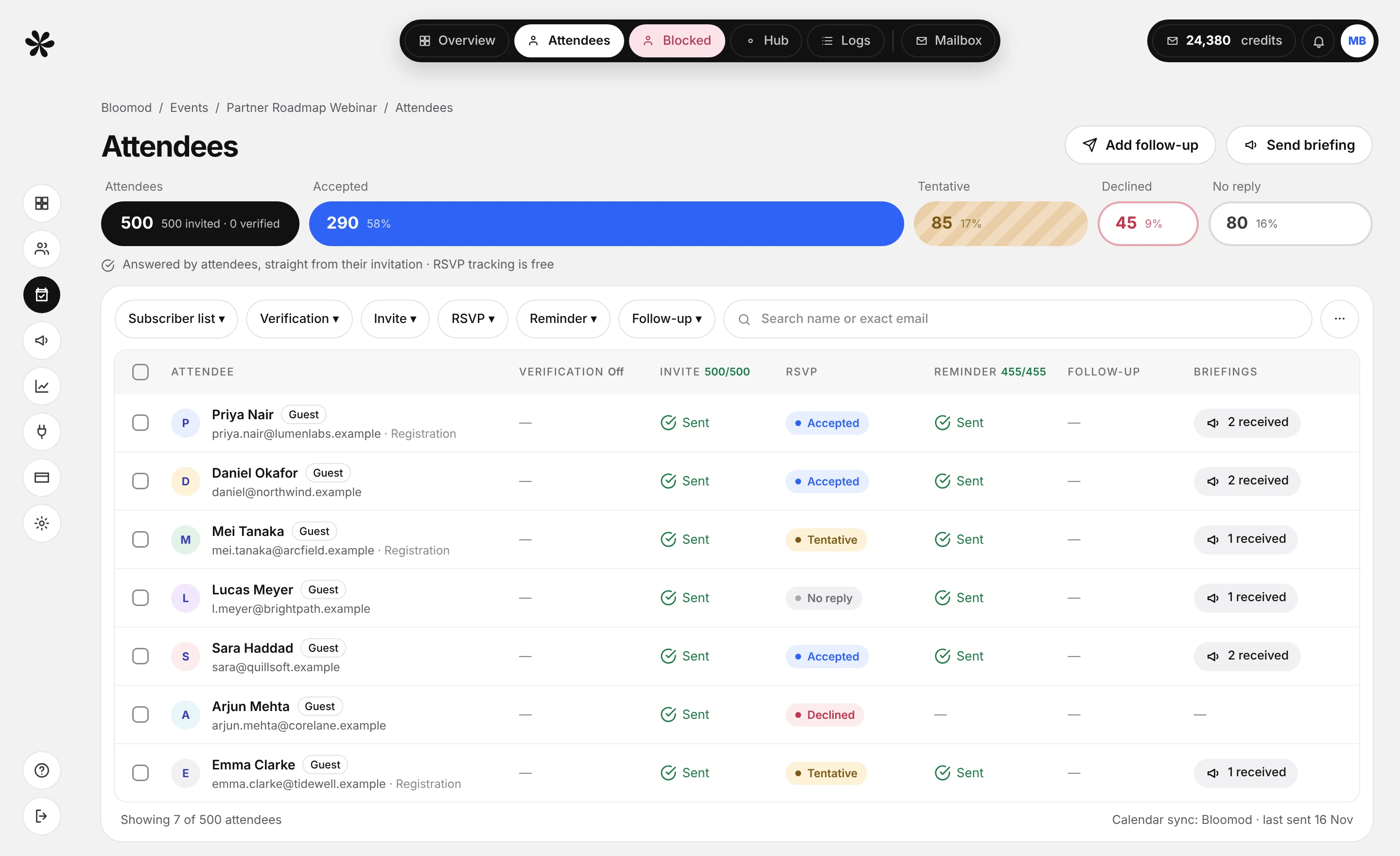
Two days before the event, the organizer's Bloomod Attendees page shows (planning figures):
| RSVP from the calendar invite | Guests | Share |
|---|---|---|
| Accepted ("Yes") | 290 | 58% |
| Tentative ("Maybe") | 85 | 17% |
| Declined ("No") | 45 | 9% |
| No reply | 80 | 16% |
| Total invited | 500 | 100% |
With open tracking alone, the organizer would only know that some of these 500 opened the email. With RSVP tracking, they know which 290 have committed, which 85 are undecided, which 80 haven't answered, and which 45 won't come.
Email opens and clicks versus calendar RSVPs
This comparison describes what each signal can tell you. It is not a measured performance result.
| Email open | Link click | Calendar RSVP | |
|---|---|---|---|
| What it records | The email's tracking image loaded | A link in the email was clicked | The guest answered Yes, Maybe or No on the invite |
| Can be triggered without a person | Yes, by privacy proxies such as Apple MPP [1] | Rarely, by link scanners | No, it needs the guest's answer |
| Tells you intent to attend | No | Partly: shows interest | Yes: a stated plan |
| Puts the event on the guest's calendar | No | No | Yes |
| Lets you segment follow-ups | Weakly | Weakly | Clearly: Accepted, Tentative, Declined, No reply |
| Best use | Rough reach | Content interest | Show-up planning and briefings |
The Bloomod RSVP workflow
- Send a calendar invite. Bloomod sends each guest a calendar invitation (an .ics invite) that appears inside their email with Yes, Maybe and No buttons. Guests don't need a form, an account or a login.
- Track every answer live. The Attendees page shows Accepted, Tentative, Declined and No reply for each guest, along with invite, reminder, follow-up and briefing status.
- Brief each group differently. Use RSVP-based briefings to send:
- Accepted: logistics, agenda and the joining link, the day before.
- Tentative: what they'll get out of the session, plus an easy way to confirm.
- No reply: a short nudge to answer the invite.
- Declined: nothing before the event. Offer the recording or the next date afterwards.
- Keep sending to late replies. Keep the Briefing sending window open until the event starts to include eligible late replies in the selected RSVP groups. Sending still depends on recipient eligibility, Email Credits and delivery rules.
- Follow up after the event. Use the same groups for thank-you notes, recordings and announcements about your next event.
Potential impact on show-up rate
The table below shows potential effects based on published research. It is not a measured Bloomod result.
| Assumption | Attendees (of 500) | Show-up rate | No-shows | Change in attendees |
|---|---|---|---|---|
| Benchmark, no plan prompt [2] | 300 | 60% | 200 | — |
| Half the research effect (+2 pp) | 310 | 62% | 190 | +10 (+3.3%) |
| Research effect (+4 pp) [4][5] | 320 | 64% | 180 | +20 (+6.7%) |
How the numbers are calculated: attendees = 500 × (60% + effect). With a +4 percentage-point effect, 500 × 64% = 320 attendees, 20 more than the benchmark, and no-shows fall from 200 to 180 (10% fewer).
The larger gain comes from what the RSVP lets you do next. Instead of one generic reminder to 500 people, the organizer can confirm logistics with 290 committed guests, give 85 undecided guests a reason to attend, and nudge 80 people who haven't answered. Those are the groups where reminders and plan-making are most likely to change behavior. [3][7]
Download the model: show-up-model.csv
RSVP tracking is free for all attendees
RSVP tracking is free in Bloomod for every attendee. Guests answer Yes, Maybe or No directly from the calendar invite in their inbox, with no account, form or login. Organizers see every answer live on the Attendees page, including on the free Seed plan, within its guest capacity.
We made RSVP tracking free because it's the signal that tells you who's actually coming. Organizers shouldn't have to pay to know that.
Limits and product boundaries
- No measured Bloomod results. The scenario uses published benchmarks and research effects. It does not report customer data.
- The research comes from other fields. The plan-making and reminder studies cover vaccination, voting and healthcare appointments. Effects at B2B events may be smaller or larger.
- An RSVP is not attendance. Some "Yes" guests won't come and some "No reply" guests will. RSVPs improve your forecast; they don't guarantee it.
- Calendar behavior varies. How invites and reminders appear depends on the guest's email and calendar app.
- Invites are free; other sending uses credits. Calendar invites, updates and cancellations through your Google or Microsoft calendar use no credits (provider limits apply). Briefings and follow-ups are emails and use Bloomod email credits according to your plan. RSVP tracking itself is free.
How to validate this on your own events
- Record your baseline. For your last two or three events, note registrants, attendees and show-up rate.
- Send calendar invites with RSVP. Use Bloomod for the next event and track Accepted, Tentative, Declined and No reply.
- Brief by RSVP group. Send separate briefings to Accepted, Tentative and No reply guests.
- Compare. Measure show-up rate against your baseline, and show-up rate within each RSVP group.
- Keep it fair. Compare similar events (same format, audience and time of year), because topic and timing affect attendance too.
Sources
- Litmus: Apple's Mail Privacy Protection Is Here: What It Actually Means for Email Marketers — how MPP pre-loads email content and records opens; Apple Mail share of opens (49.8%, August 2021).
- ON24: Key takeaways from the Webinar Benchmarks Report — average registrant-to-attendee conversion rate of 60% in 2025.
- Gollwitzer, P. M., & Sheeran, P. (2006). Implementation intentions and goal achievement: A meta-analysis of effects and processes. Advances in Experimental Social Psychology, 38, 69–119. — 94 tests, d = 0.65.
- Milkman, K. L., Beshears, J., Choi, J. J., Laibson, D., & Madrian, B. C. (2011). Using implementation intentions prompts to enhance influenza vaccination rates. PNAS, 108(26), 10415–10420. — date-and-time plan prompt: 33.1% to 37.1% vaccination.
- Nickerson, D. W., & Rogers, T. (2010). Do you have a voting plan? Implementation intentions, voter turnout, and organic plan making. Psychological Science, 21(2), 194–199. — +4.1 pp turnout among those contacted.
- Rogers, T., Milkman, K. L., John, L. K., & Norton, M. I. (2015). Beyond good intentions: Prompting people to make plans improves follow-through on important tasks. Behavioral Science & Policy, 1(2), 33–41. — why scheduling and calendar commitments improve follow-through.
- Robotham, D., Satkunanathan, S., Reynolds, J., Stahl, D., & Wykes, T. (2016). Using digital notifications to improve attendance in clinic: systematic review and meta-analysis. BMJ Open, 6(10), e012116. — 26 studies; attendance 67% vs 54% (RR 1.23).
This case study presents a planning scenario based on published research and benchmarks. It does not claim measured results from Bloomod customers.