RSVP vs Real Attendance for Online and In-Person Events
What a yes can’t tell you, and how check-in fills the gap.
Published research from Harvard, MIT, Sheffield and the UK Behavioural Insights Team shows how far stated intent sits from real attendance. Here is how Bloomod records both, online and in person.
THE NUMBERS BEHIND THIS CASE STUDY
of people who said they would vote did not
Three elections, 29,403 people, checked against voting records. Rogers & Aida, Harvard Kennedy School, 2014.
of online registrations never went past signing up
292,852 of 841,687 registrations across 17 courses. Ho, Reich et al., HarvardX and MITx, 2014.
missed appointments when the reminder was specific
Randomised trial with 10,111 patients, replicated at 8.2%. Hallsworth et al., PLoS ONE, 2015.
fewer chronically absent students
When parents got accurate attendance records. 28,080 students. Rogers & Feller, Nature Human Behaviour, 2018.
By Bloomod · Last reviewed 21 Nov 2026
Quick answer
An RSVP tells you who plans to come. A check-in tells you who came. Research on stated intentions is consistent: people who say yes often don't follow through, and some who say no turn up anyway. Bloomod records both signals on the same Event. Guests answer Going, Maybe or No on the calendar invite; then they check in at the door with a QR entry pass, or join online through a personal link that records the join. With both, you can brief each RSVP group before the day, see who actually attended, and follow up only with the people who came.
The gap between saying yes and showing up
People's predictions about their own behavior are unreliable
Harvard Kennedy School researchers Todd Rogers and Masahiko Aida compared what 29,403 people said they would do before three US elections with official voting records afterwards. [1]
| Election surveys | Said they would vote, but did not | Said they would not vote, but did |
|---|---|---|
| 2008 General Election | 13.3% | 54.2% |
| 2009 New Jersey General Election | 54.2% | 29.3% |
| 2011 Wisconsin Recall Election | 17.3% | 39.5% |
Both errors matter for events. Some of your "Going" guests will not arrive, and some people who never said yes will.
Raising intent raises behavior by less
A meta-analysis of 47 experiments by Thomas Webb and Paschal Sheeran found that a medium-to-large change in intention (d = 0.66) produced only a small-to-medium change in behavior (d = 0.36). [2] Winning more "yes" replies helps, but it does not translate one-for-one into people in the room.
Online sign-ups show the same pattern
In the first year of HarvardX and MITx open online courses, 841,687 registrations were recorded. 292,852 of them (34.8%) never went past registering, and 43,196 (5.1%) earned a certificate. [3] Signing up online costs almost nothing, so a registration is an even weaker signal than a calendar reply. For webinars, ON24 reports an average registrant-to-attendee rate of 60% in 2025. [4]
These studies measure voting, online courses, hospital appointments and school attendance, not B2B events. We use them to show the size and direction of the gap, not to predict your numbers.
What helps close the gap
- Specific reminders. In a randomised trial with 10,111 hospital outpatients, a reminder that stated the specific cost of a missed appointment cut the missed-appointment rate from 11.1% to 8.4%. A second trial (9,848 patients) replicated it at 8.2%, while a general version of the same message did worse (9.9%). [5] What a reminder says, and to whom, matters.
- Accurate attendance records. In a Harvard-led experiment with 28,080 students, parents who received accurate, personalised attendance information, correcting their underestimates of their children's absences, reduced chronic absenteeism by 10% or more. [6] People act better on real attendance data than on their own impressions.
For events, that points to two habits: brief each RSVP group with specific content, and measure real attendance rather than assuming RSVPs came true.
How Bloomod records RSVPs and attendance
Every guest gets one personal link inside the calendar invitation they already receive, through Google Calendar, Microsoft Outlook or a Bloomod email invitation. There is nothing to set up: attendance is on for every Event.
| In-person Event | Online Event | |
|---|---|---|
| Before the day | Going, Maybe or No from the calendar invite | Going, Maybe or No from the calendar invite |
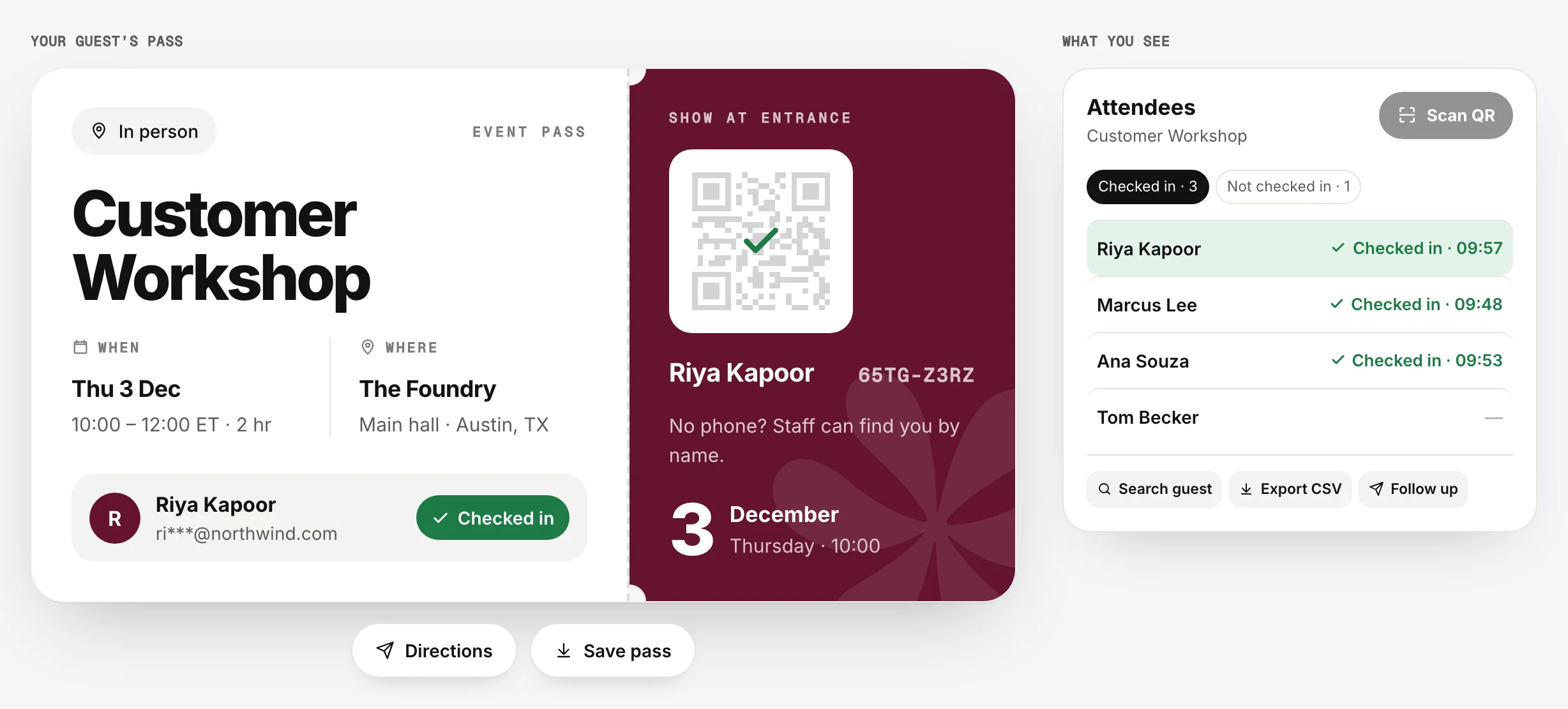
| What the guest opens | An entry pass with a QR code, name, reference code and directions | A pass with a Join button; joining opens 15 minutes before the start |
| What is recorded | Checked in, after the organizer scans and confirms | Joined, with the first and last join time |
| Guests without a phone or pass | Search by name or email and check in by hand | Mark attendance after the session |
| What counts as attended | Checked in | Checked in, confirmed with Mark attendance |
| After the Event | Filter, export CSV, Follow-up to Checked in | Filter, export CSV, Follow-up to Joined online |
In person: QR check-in at the door
- The guest opens View entry pass from the invite and shows the QR code, on screen or printed.
- You open Attendees → Scan QR and scan with Bloomod's scanner, a phone camera or a USB scanner.
- Bloomod shows the guest's name, email and registration answers. Nothing is recorded until you choose Confirm check-in.
- A code scanned at two doors at the same moment is counted once, and Undo attendance keeps the original record.
Online: recorded joins
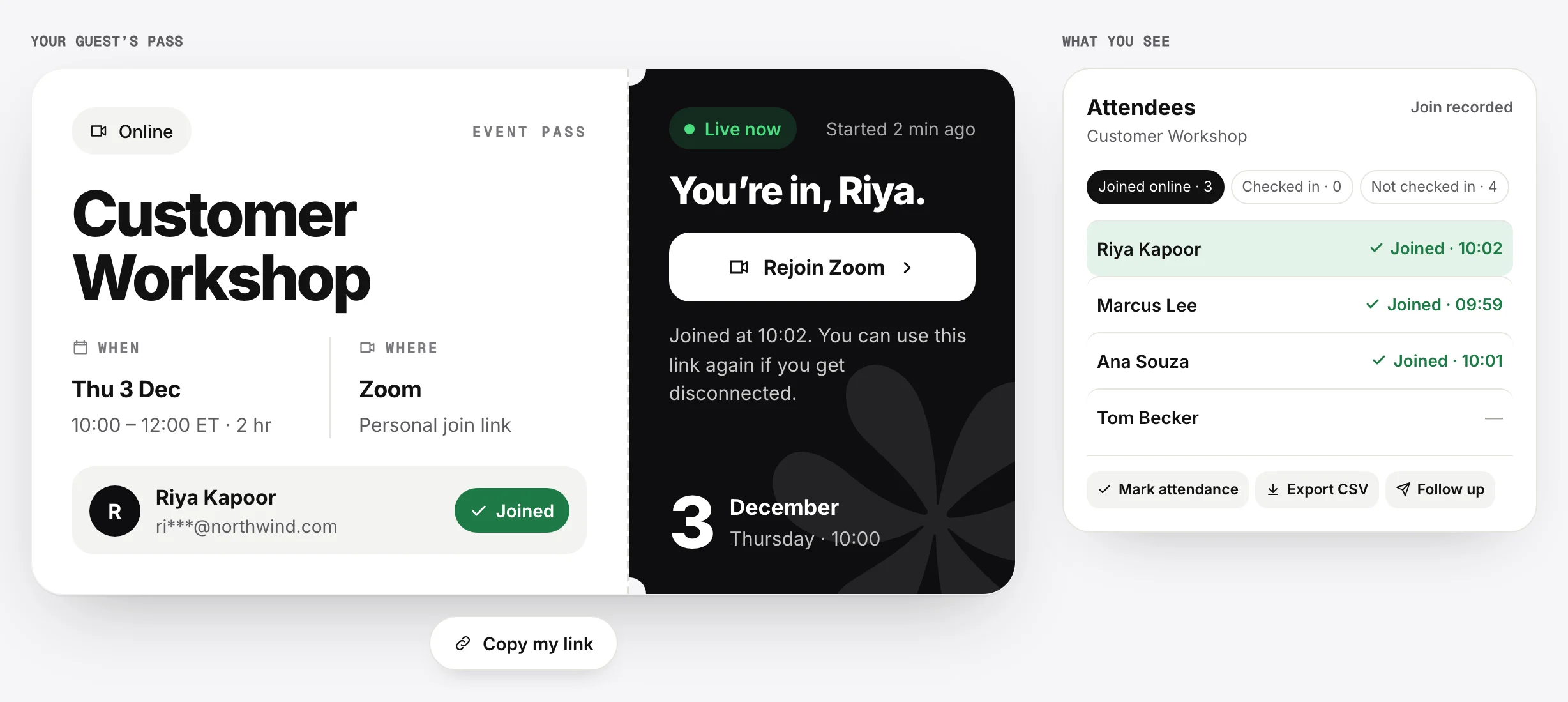
- The guest presses Join meeting on their pass. Opening the link alone records nothing, so email scanners can't mark anyone as joined.
- Bloomod records the first and last join time, then sends the guest straight to Google Meet, Microsoft Teams or Zoom.
- After the session, compare Joined online with the meeting platform's participant list and use Mark attendance for everyone who stayed.
From RSVP to briefing to check-in
- RSVP: guests answer Going, Maybe or No on the calendar invite.
- Briefing: send each group what it needs: details for Going, the value of the session for Maybe, a nudge for people who haven't replied.
- Check-in: record who actually came, at the door or online.
- Compare: set each RSVP group against who checked in or joined, and adjust the next Briefing.
- Follow up: send the recap only to Checked in or Joined online, and something different to people who missed it.
Limits and product boundaries
- No Bloomod customer results. Every figure comes from the cited studies in other fields.
- Joined is not time in the call. Bloomod records that a guest joined, not how long they stayed.
- Forwarded links work for whoever holds them until they close, so staff should check the name the scanner shows.
- The scanner needs an internet connection, and today only the workspace owner can check guests in.
- Shared calendar entries (one event for all guests) can't carry personal links.
Sources
- Rogers, T., & Aida, M. (2014). Vote self-prediction hardly predicts who will vote, and is (misleadingly) unbiased. American Politics Research, 42(3), 503–528. Harvard Kennedy School. Seven surveys, N = 29,403, validated against voting records.
- Webb, T. L., & Sheeran, P. (2006). Does changing behavioral intentions engender behavior change? A meta-analysis of the experimental evidence. Psychological Bulletin, 132(2), 249–268. 47 experiments; intention d = 0.66, behavior d = 0.36.
- Ho, A. D., Reich, J., Nesterko, S., Seaton, D. T., Mullaney, T., Waldo, J., & Chuang, I. (2014). HarvardX and MITx: The first year of open online courses. HarvardX and MITx Working Paper No. 1. 841,687 registrations; 292,852 never went past registration; 43,196 certificates.
- ON24: Key takeaways from the Webinar Benchmarks Report. Industry benchmark: 60% average registrant-to-attendee rate in 2025.
- Hallsworth, M., et al. (2015). Stating appointment costs in SMS reminders reduces missed hospital appointments: findings from two randomised controlled trials. PLoS ONE, 10(9), e0137306. 11.1% to 8.4% (Trial One), 8.2% (Trial Two).
- Rogers, T., & Feller, A. (2018). Reducing student absences at scale by targeting parents' misbeliefs. Nature Human Behaviour, 2. 28,080 students; chronic absenteeism reduced by 10% or more.
Every figure comes from the cited studies, which measured voting, online courses, hospital appointments and school attendance, not B2B events. The product screens show a fictional example Event. This is not a report of Bloomod customer results.